PROJECTS IN DIALOGUE / ITHACA TO SINGAPORE
Two projects.
A closer reading.
Choose two projects and read them through one question. Which checks are worth borrowing, and which conditions need rethinking? Follow the sources, contributions and later exercises into the particulars.
NINE PROJECTS / FOUR PERSPECTIVES / EDITED OCTOBER 2026Begin with a pairing. Or make your own.
One question. Two approaches.
Kopi & Co × Bikes, docks and competing objectives / Frame the question
NUS / Digital transformation / 2026
Kopi & Co
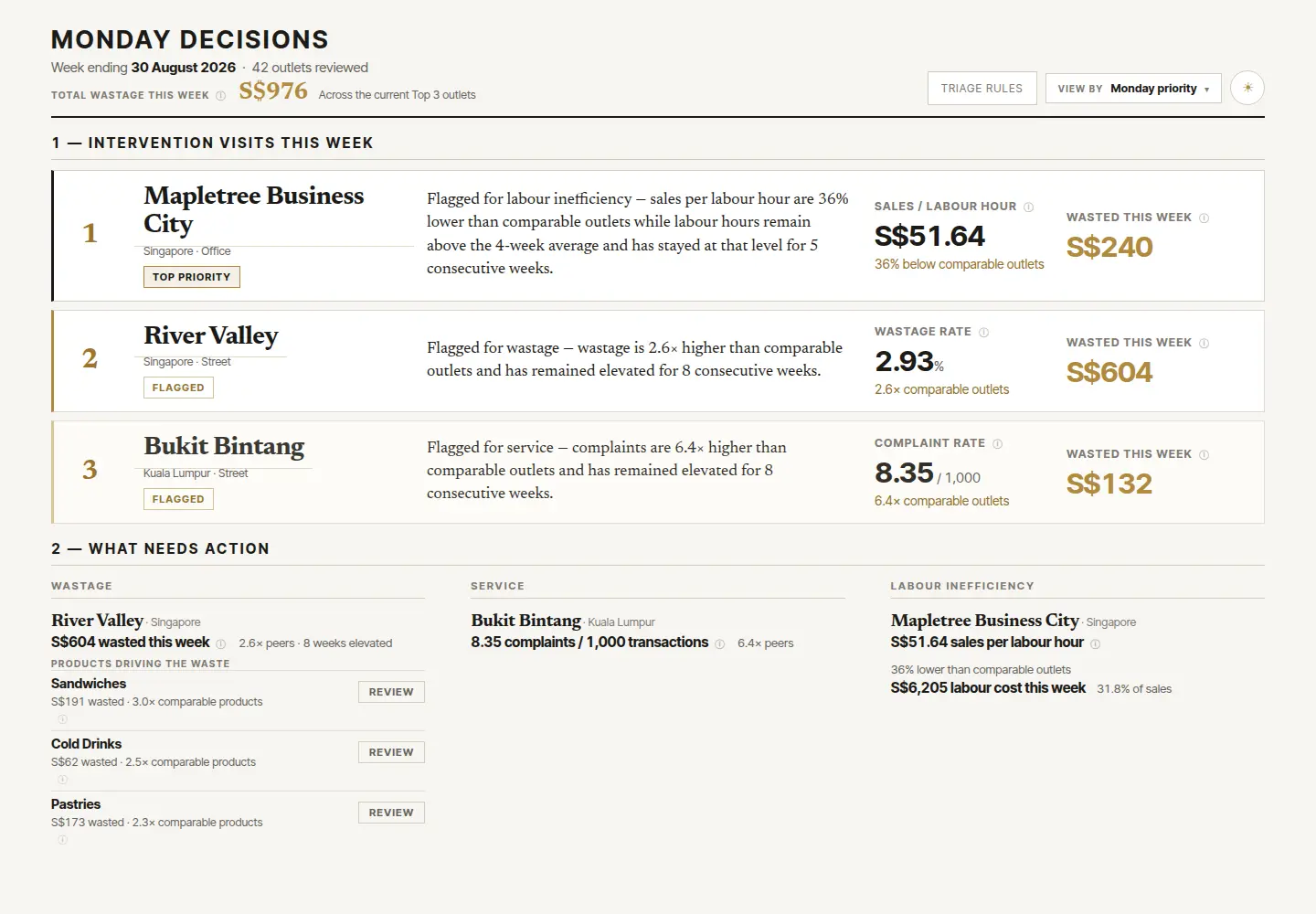
What can these records help someone decide?
My role and the material's context
I developed the initial individual branch and contributed to the group prototype. The case preserves the different dataset versions and the later individual reflection.
The team prototype, my individual branch and the later website exercise have different data scopes.
Cornell / CHEME/SYSEN 6800 / 2022
Bikes, docks and competing objectives
Does the implementation express the intended objective?
My role and the material's context
I participated in formulating an academic model of bike allocation, station capacity, relocation costs and unmet demand.
The original implementation was incomplete. The website lab is an illustrative exercise, with its own inputs and assumptions.
Frame the question
A / Kopi & Co
What can this row support?
The initial outlet-week data could guide attention to an outlet. A product-line decision required more detailed evidence.
B / Bikes, docks and competing objectives
What makes leaving every bike still look cheap?
The course model puts relocation cost beside unmet rental and return demand. If the penalty for unmet demand is absent from the implementation, leaving bikes in place can look attractive for the wrong reason.
Organise the evidence
A / Kopi & Co
Keep the versions distinct.
504 × 15 describes the initial academic data. The final group artifact contains 3024 × 22 synthetic product records; the versions have different identifiers.
B / Bikes, docks and competing objectives
Keep the formulation and the implementation in view.
The original report records an incomplete implementation and zero relocations. The later three-station website lab uses its own illustrative inputs to make the objective and feasible moves inspectable.
Handle a change
A / Kopi & Co
A new schema changes the question.
Moving from outlet-week rows to synthetic product rows changes the available detail. Repeated outlet totals require care before aggregation.
B / Bikes, docks and competing objectives
The weight matters only after the term exists.
Changing a penalty weight is useful when unmet demand is correctly represented. In the website lab, changing prices can move the preferred relocation plan; the original implementation needs the missing terms addressed first.
Check the judgment
A / Kopi & Co
Can someone explain the recommendation?
Read the screen, the evidence behind it and the limits of the dataset together. A polished interface still needs an interpretable basis for action.
B / Bikes, docks and competing objectives
Return to someone looking for a bike or dock.
A lower cost needs an explanation in service terms: which rentals or returns remain unmet, which bikes move and which capacities bind? The numerical optimum is easier to understand alongside those consequences.
SOURCE ROUTES / CONTINUE THE READING
Nine projects, with more behind each one.
The comparison is a present-day editorial reading. Follow each project for its original date, individual contribution and material scope.
Kopi & Co
I developed the initial individual branch and contributed to the group prototype. The case preserves the different dataset versions and the later individual reflection.
The team prototype, my individual branch and the later website exercise have different data scopes.
Open the three-step project route ↗From requirements to acceptance
At Hangzhou Huizhi I organised requirements, fields, prototypes, calculation logic and acceptance across eight-plus workflows. The public examples reconstruct the method with fictional rules.
The examples are a later reconstruction of the working method, grounded in the roles described in my CV.
Open the three-step project route ↗A school as a system
I served as Community team lead and coordinated with sustainability and building work. My individual SYSEN 5190 plan and life-cycle report are read separately from the team reports.
The case distinguishes my individual source work, team coordination and the proposed school concept.
Open the three-step project route ↗A greenway as a system
I applied systems architecture and optimisation concepts, using Python and R to generate and analyse randomised datasets and support design recommendations.
The greenway team report uses generated architectures and simulated survey data; Offer Studio uses a separate fictional commission.
Open the three-step project route ↗Bikes, docks and competing objectives
I participated in formulating an academic model of bike allocation, station capacity, relocation costs and unmet demand.
The original implementation was incomplete. The website lab is an illustrative exercise, with its own inputs and assumptions.
Open the three-step project route ↗Service, scope and cost
I co-developed a project management plan covering stakeholders, needs-to-goals traceability, organisation, work breakdown, schedule, labour cost, budget and risk.
The budgets are course planning assumptions. The website schedule and resource exercises use illustrative data.
Open the three-step project route ↗A digital presence for a place
I developed design-thinking concepts for the district’s digital presence, stakeholder engagement and place branding.
Cherry Street is a design proposal. The linked participation studio extends a different project as an editorial comparison.
Open the three-step project route ↗From the grid to the bricks
This is my individual Product & Brand Management Quick Take. The participation studio is a later website extension of its argument.
The analysis follows the individual presentation; the three-route studio is a later website extension.
Open the three-step project route ↗More than a price
I participated in the three-person seller team. The source reflection is team work; the website commission models were created later.
The classroom simulation, Bugis purchase and fictional offer model are separate experiences.
Open the three-step project route ↗
AFTER READING / THE CONVERSATION
What would you add?
Add an experience, ask a question or point out a correction. Both language editions share this article’s discussion.
Public comments are not open yet. Keep a draft on this device, or send your thoughts through the contact page.
Write a local draft
Only “Save on this device” stores the draft. Clear it on shared devices; it is not published automatically.
0 / 1600