THE ORIGINALS / NINE PIECES, THREE ROOMS
Look closer.
An interface, a model figure, a character scene. Open the work, with the question, contribution and creative process beside it.

At Cornell, the team report connected stakeholder needs with alternatives and evaluation. At NUS, Kopi brought questions into an interface someone could operate. Beyond coursework, character studies gave me another way to ask how a brief becomes something visible.
Visit each room at its own pace, or put two pieces side by side. Commentary, source context and case links sit beside the images, so a small detail can lead into a fuller story.
CHOOSE A ROOM, OR FOLLOW ALL NINE PIECES.
The originals, opened up.
1 / 9 · Begin with the Monday decision.
SCREEN 01Begin with the Monday decision.+
SCREEN 01 / An interface for a decision
Begin with the Monday decision.
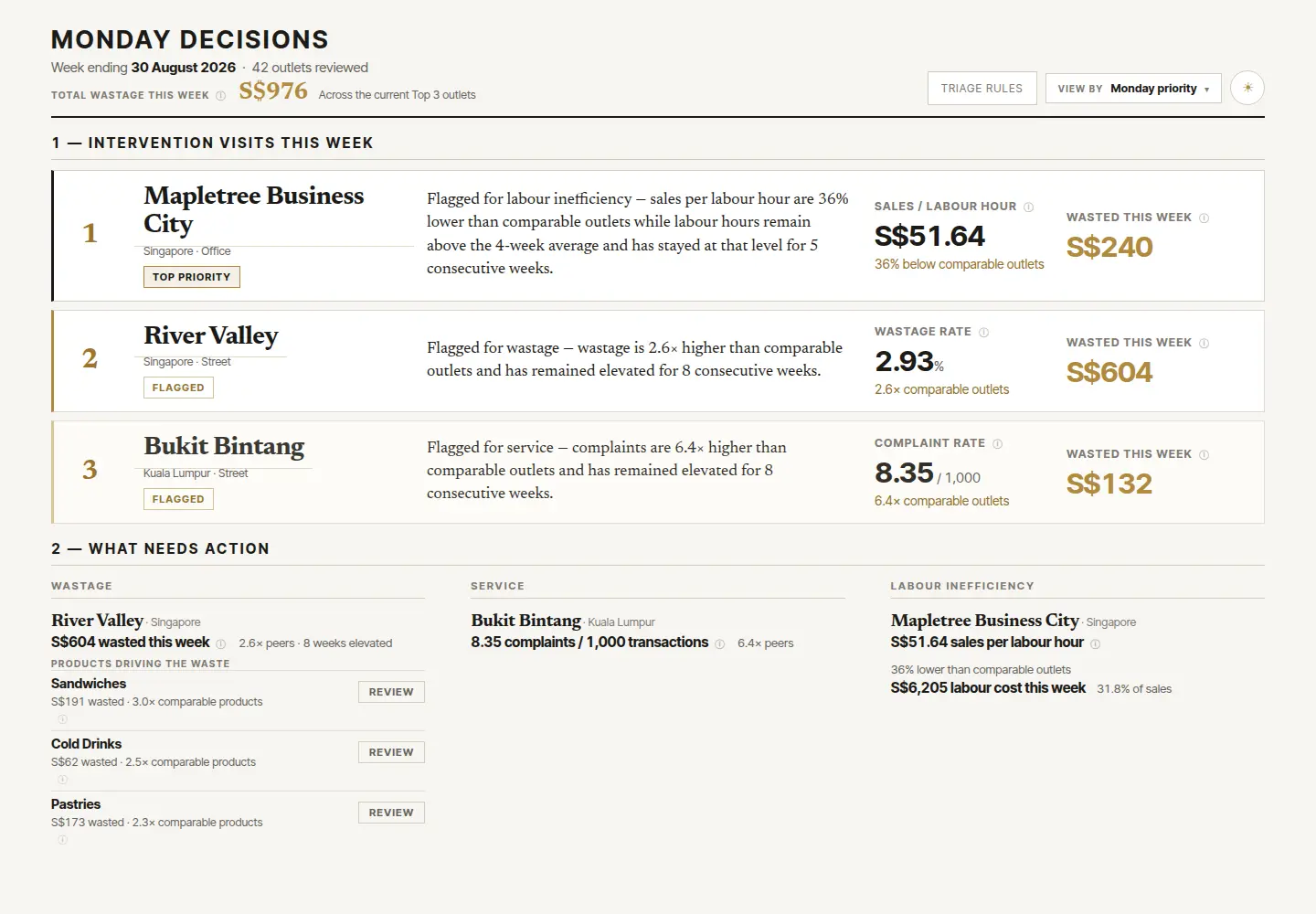
The Monday screen is the entrance to our Kopi & Co group prototype. It organises the demonstration around the operating decisions a fictional COO needs to prepare, rather than asking the reader to begin with the full dataset.
I look at the order of attention: what can someone recognise immediately, and where can they go to inspect the basis for a recommendation? This is an interface from an academic demonstration using synthetic data.
Which question gets attention first?
THREE WAYS TO LOOK CLOSER / OPEN EACH NOTE
Follow the reading order+
Begin with the outlets needing attention this week, then inspect the proposed actions. The two sections let a reader ask separately where to look and what to prepare next.
Put the amount beside the question+
Waste, labour and service are different measures. Establish what each number represents, then return to the outlet and rule to understand why it appears.
Carry one decision forward+
Choose a recommendation and name the information you would need before acting. For a product or roster decision, use the full case to check the data’s granularity and available detail.
FROM THE ORIGINAL / TRY A NEXT STEPMake a Monday call yourself.+
After inspecting the entrance screen, follow the evidence into a choice in the decision theatre.
- Choose the issue you want to prioritise.
- Inspect the samples and make your next call.
- Open the review and revisit your reasoning.
Which piece of evidence changed your choice?
Enter the Kopi Decision TheatreKopi & Co / Final group prototype / September 2026 / Synthetic academic data
Read the original context and case ↗SCREEN 02Follow a recommendation into its detail.+
SCREEN 02 / An interface for a decision
Follow a recommendation into its detail.
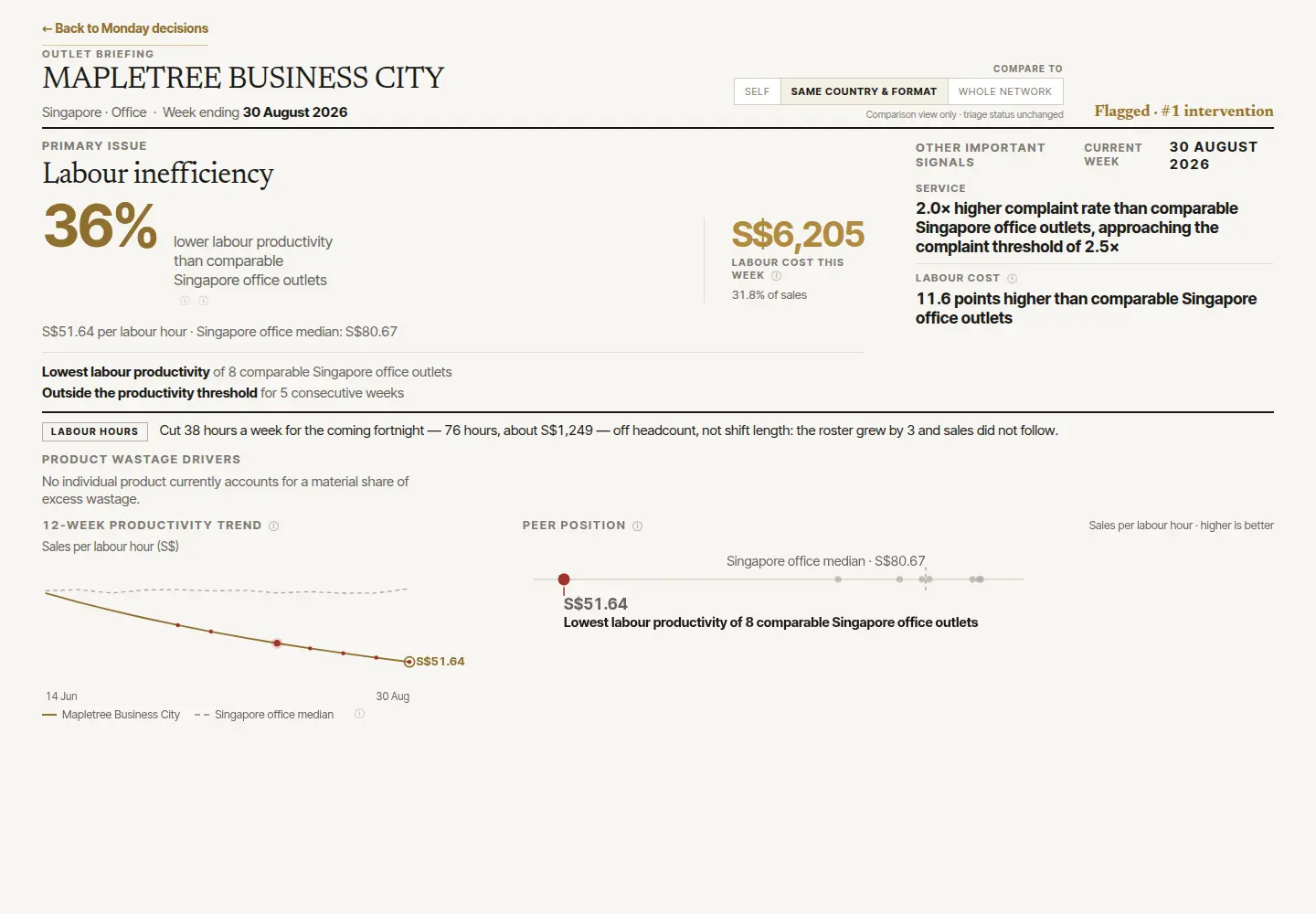
The drill-down screen is the next layer of the prototype. It gives a selected question more room, connecting a summary with the information a reader needs to inspect.
The individual branch and group final use different data structures. When moving from a screen to a recommendation, I want the meaning of a row and the source of a value to remain visible. The full case explains those versions beside the working artifact.
What would you check before acting?
THREE WAYS TO LOOK CLOSER / OPEN EACH NOTE
Move from overview to detail+
Put this beside the Monday screen and follow how one question opens up. As detail increases, the reader should still be able to find the issue they came to inspect.
Check that the object is the same+
Establish the outlet, period and measure definition. The individual branch and group final have different data structures, so keep the version in view when comparing them.
Name the missing information+
Frame the next step as a specific question: what is missing, and which decision could it change? The evidence studio continues this comparison across management questions.
FROM THE ORIGINAL / TRY A NEXT STEPPrepare the next useful question.+
Take the detail into the evidence studio and inspect what different decisions require.
- Choose an outlet, labour or product question.
- Assume a relevant set of evidence becomes available.
- Compare the versions and name what still needs checking.
Which missing information could change the next action?
Open the evidence studioKopi & Co / Final group prototype / September 2026 / Synthetic academic data
Read the original context and case ↗SCREEN 03Let the rule become inspectable.+
SCREEN 03 / An interface for a decision
Let the rule become inspectable.
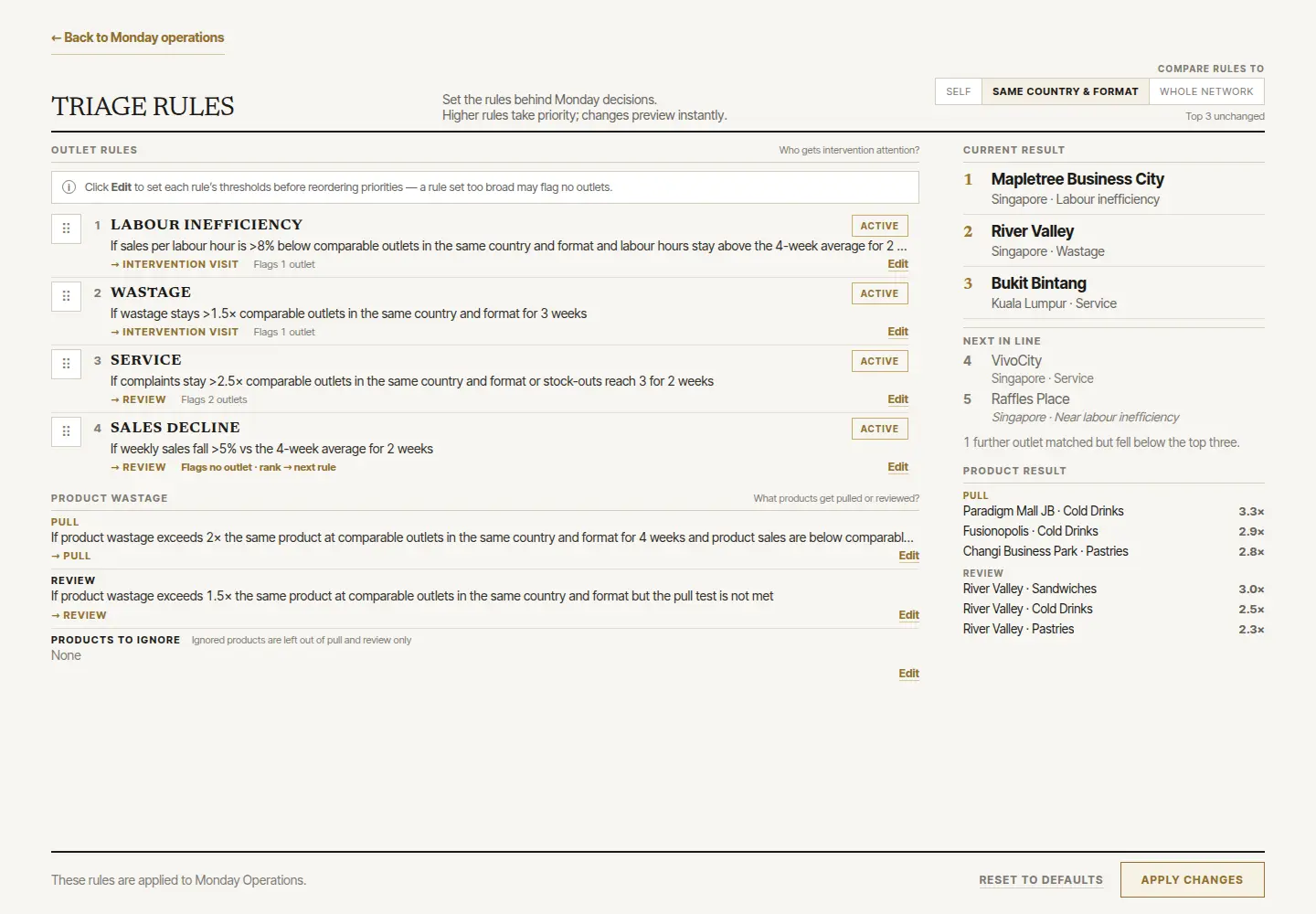
The rule panel makes part of the prototype’s management logic available for inspection. A threshold or priority is a choice about how the system responds, as well as a setting in an interface.
Our presentation recorded an interaction between thresholds and priorities. I return to the visible behaviour after a change: which rule fired, which result moved, and how could someone explain it? The case and later decision tools continue that line of inquiry.
What should change when a threshold changes?
THREE WAYS TO LOOK CLOSER / OPEN EACH NOTE
Read the setting as a condition+
Choose a threshold or priority and describe the condition it establishes. An interface adjustment should correspond to an explainable rule.
Return to the triggered result+
A rule change may alter the shortlist or leave it unchanged. Inspect which records triggered the condition and what happens when several rules apply together.
Keep a reproducible example+
Retain the setting, input and expected result for one change. Another reader can then follow the same example instead of inferring the logic from a visual change alone.
FROM THE ORIGINAL / TRY A NEXT STEPCheck a rule with concrete examples.+
Move to the requirements case’s illustrative rules and connect a setting to behaviour someone can verify.
- Find the rule-change comparison.
- Inspect normal, boundary and incomplete-input cases.
- Compare the versions and identify changed routes.
Could another person reproduce the check from the same example?
Inspect the requirements caseKopi & Co / Final group prototype / September 2026 / Synthetic academic data
Read the original context and case ↗FIG. 2.5Ask whose needs became goals.+
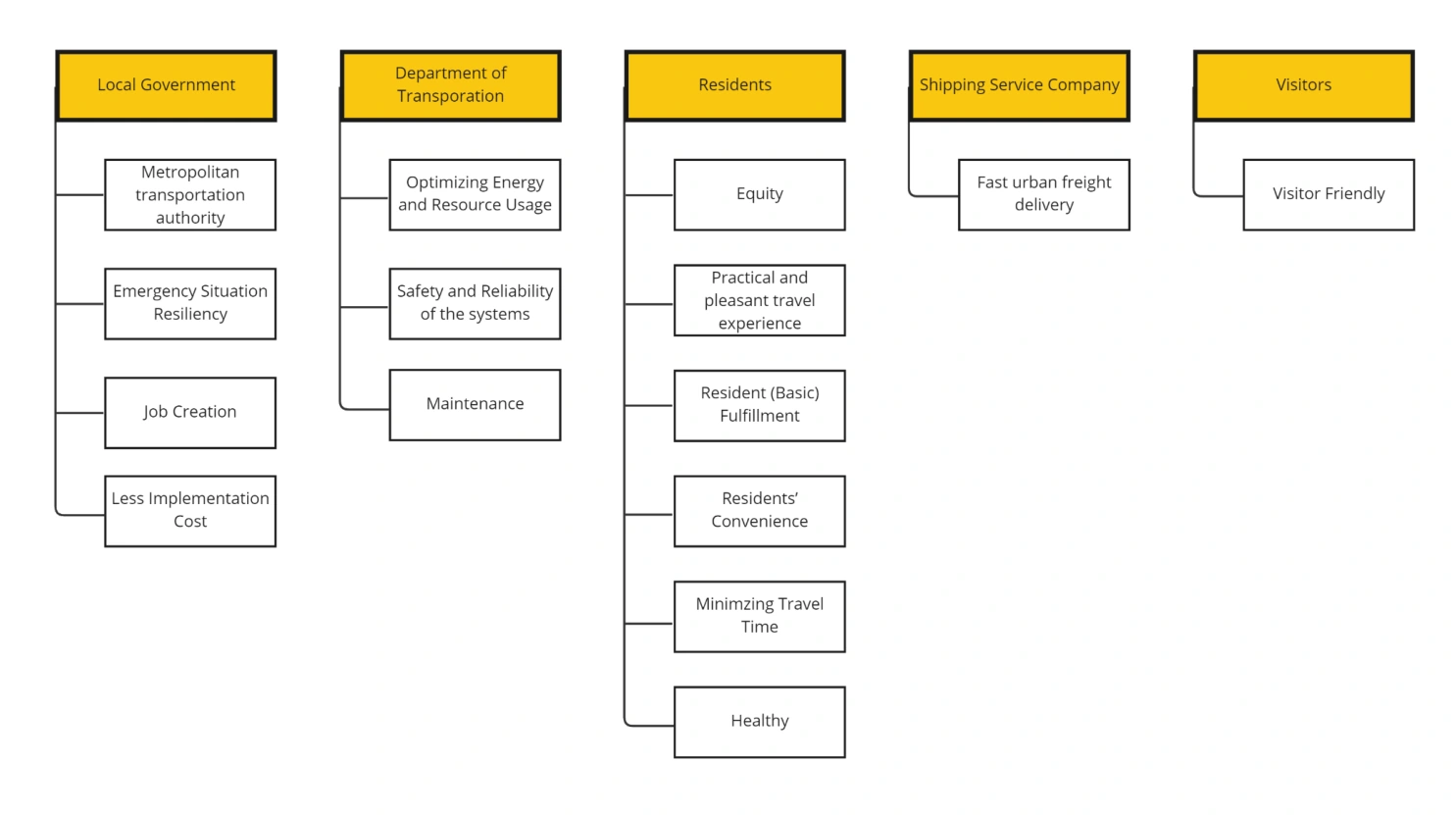
FIG. 2.5 / A model, opened up
Ask whose needs became goals.
Residents, visitors, transport agencies and local organisations expect different things from a greenway. The original diagram separates those needs so that later measures can be traced back to the people they are meant to serve.
Before comparing alternatives, I want to know whose needs were included. This figure gives the later model a set of people and purposes to return to. It is one part of a team report, read here alongside my contribution and present-day questions.
Whose experience could disappear from the ranking?
THREE WAYS TO LOOK CLOSER / OPEN EACH NOTE
Recognise the people in the diagram+
Choose residents, visitors, transport agencies or local organisations and follow their relationships. The same greenway can serve different purposes for different people.
Connect a need to a goal+
Follow a need into a design goal, then ask whether the later measure responds to it. A clear goal gives the comparison something to return to.
Try an additional perspective+
Imagine a user group whose needs received less attention. Which goal might change? This is a present-day reading exercise to carry into the full project.
FROM THE ORIGINAL / TRY A NEXT STEPFollow a need into another project.+
Move from the greenway diagram to the school project and inspect how a user need reaches design and coordination.
- Read the project context and contribution.
- Open a theme in the interactive system map.
- Inspect the design, maintenance and team checks around it.
If a need changes, who needs to follow it through?
Open the sustainable-education casePedestrian Greenway Optimization System / Team report / 17 May 2023 / Report pp. 11
Read the original context and case ↗FIG. 3.9Put ten thousand candidates on the same page.+
FIG. 3.9 / A model, opened up
Put ten thousand candidates on the same page.
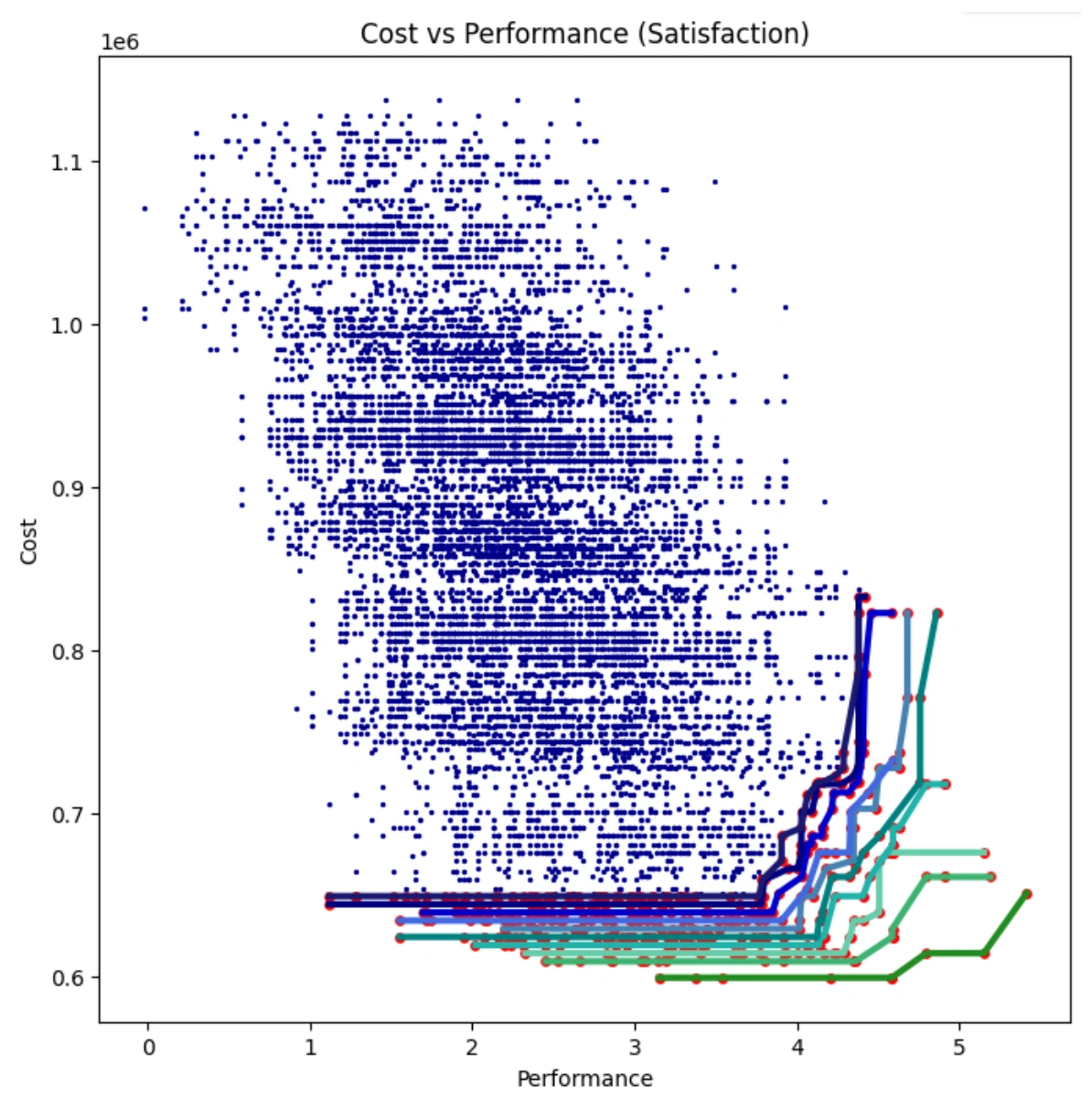
The horizontal axis is the report's performance measure; the vertical axis is modelled cost. The points show the candidate distribution, while the fronts narrow the comparison. Read the metric definitions and input sources alongside the pattern.
A frontier can help narrow a set of alternatives; choosing among them still needs a reason. The report’s simulated survey inputs matter to that interpretation. These are results inside the course model, rather than observed effects of a built greenway.
Why do options on the same frontier still need comparison?
THREE WAYS TO LOOK CLOSER / OPEN EACH NOTE
Read the axes before the points+
The horizontal axis is the report’s performance measure; the vertical axis is modelled cost. Establish their meanings before inspecting the candidate distribution.
Ask what the frontier narrowed+
The fronts help the team concentrate on a subset of alternatives. Options that remain still need comparison against stakeholder needs and the evaluation definitions.
Keep the inputs in view+
The report uses generated architectures and simulated survey inputs. What field evidence would matter when using the method in an actual setting? Name one input that could affect the comparison.
FROM THE ORIGINAL / TRY A NEXT STEPCompare cost and service yourself.+
The bike-rebalancing lab offers another hands-on comparison, using its own illustrative assumptions.
- Read the bike lab’s inputs and objectives.
- Change the cost weights and inspect the alternatives.
- Distinguish the ranking from the Pareto frontier.
Which objective is driving your chosen option?
Enter the bike-rebalancing labPedestrian Greenway Optimization System / Team report / 17 May 2023 / Report pp. 34–35
Read the original context and case ↗FIG. 3.13Then inspect which choices reach further.+
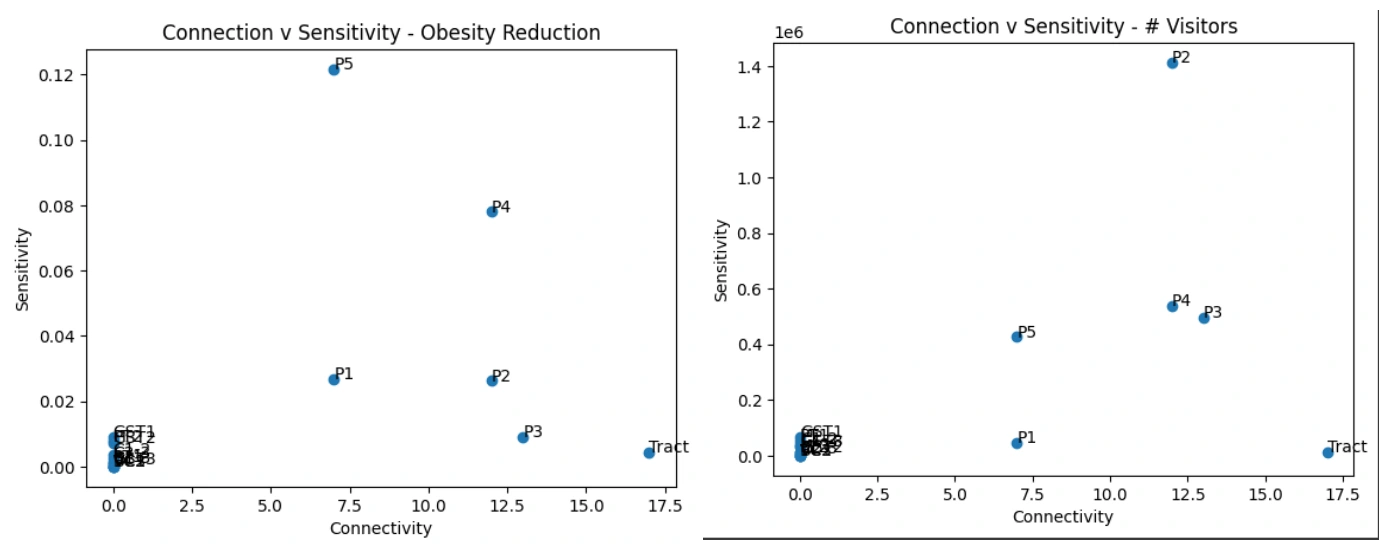
FIG. 3.13 / A model, opened up
Then inspect which choices reach further.
The pair of charts compares decision connectivity with metric sensitivity, helping the team discuss what to inspect first. Health-related and visitor measures here belong to the course model; the exhibit shows the analytical process.
Sensitivity is a useful invitation to inspect an assumption. I would read it beside the importance of the need, the feasibility of a change and the quality of the inputs. The original pair of charts makes that discussion more concrete.
Does a sensitive measure automatically deserve priority?
THREE WAYS TO LOOK CLOSER / OPEN EACH NOTE
Read the two analyses separately+
Identify the modelled measure in each set, then inspect decision connectivity and sensitivity. Reading both helps identify choices worth investigating.
Ask what follows from sensitivity+
An input that strongly affects a result deserves inspection. Whether to prioritise changing it also depends on the importance of the need, input reliability and implementation constraints.
Choose an assumption to inspect+
Select a decision and name the input or relationship you would verify. Returning to the original with that question gives the analysis a practical next step.
FROM THE ORIGINAL / TRY A NEXT STEPChange a priority. Revisit two offers.+
A fictional commission in Offer Studio explores another assumption change: keep the terms and change what one side values.
- Inspect the starting A and B terms.
- Switch the client’s preference model.
- Read the scores and floors, then trace what changed.
Did the offer change, or the assumptions used to evaluate it?
Enter Offer StudioPedestrian Greenway Optimization System / Team report / 17 May 2023 / Report pp. 40
Read the original context and case ↗STUDY 01The astral lecturer+
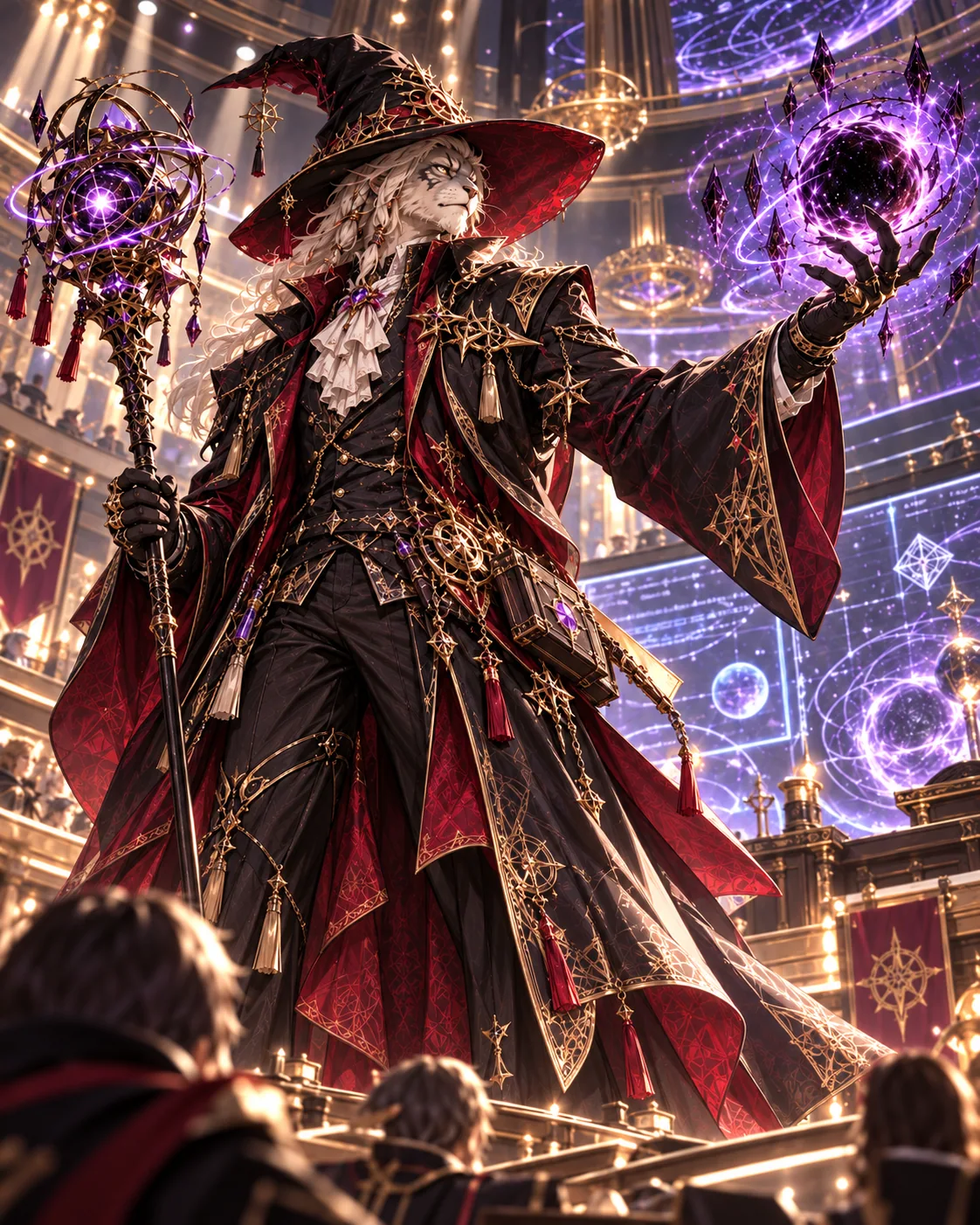
STUDY 01 / An idea becomes a scene
The astral lecturer
The brief gave the black mage a role: a lecturer. That made the costume, staff and surrounding objects part of a setting with a purpose. I enjoy the way an identity can organise a detailed scene.
Look at the relationship between the character and the room. Which props suggest teaching, and which create atmosphere? My role was to shape the brief and revision direction; the image was made with AI assistance.
Which detail makes the lecturer’s role readable?
THREE WAYS TO LOOK CLOSER / OPEN EACH NOTE
Read the role through the props+
Inspect the staff, robes and lecture-room diagrams. What does each contribute to the lecturer’s identity? Choose one detail and describe its purpose in the setting.
Place the character in the room+
Move your attention from the character to the surrounding space. How do light, diagrams and furnishings suggest an imagined magic lesson? This develops the role in the creative brief.
Leave one revision request+
If you could change one detail, would you clarify the lecturer’s role or strengthen the atmosphere? Name a prop or action so the next discussion has a concrete starting point.
FROM THE ORIGINAL / TRY A NEXT STEPMake one revision request concrete.+
Return to the creative notebook and inspect roles, props and scene requirements beside the complete work.
- Choose a detail in the lecturer study.
- Read the brief and detail commentary together.
- Form one specific request for another creative attempt.
Would someone know what to change, and why?
Continue in the creative notebookPersonal creative direction / AI-assisted FFXIV-inspired fan art
Read the original context and case ↗STUDY 02A moonlit catfish mage+
STUDY 02 / An idea becomes a scene
A moonlit catfish mage
The catfish character takes the scholarly idea in a gentler direction. A pointed hat, small glowing companions and a moonlit library give the image a different rhythm from the Hrothgar lecturer.
I read this as another creative direction: which choices make it feel playful while preserving the scholarly setting? The complete creative notebook keeps the original image beside the brief and later observations.
What changes the mood while keeping the role?
THREE WAYS TO LOOK CLOSER / OPEN EACH NOTE
Notice the lighter mood+
The hat, expression and glowing companions take the scholarly character in a more playful direction. Choose the detail that most changes the mood for you.
Look at the setting’s contribution+
Moonlight and the library give the character an imagined space. Put this beside the Hrothgar lecturer to compare two expressions of a scholarly theme.
Imagine another scene brief+
Keep the character and change what it is doing. Would you specify an action, prop or place first? This new exercise can begin with one concrete requirement.
FROM THE ORIGINAL / TRY A NEXT STEPGive a newcomer a place to begin.+
Move from an inviting character to the F1 × LEGO study and inspect a first action someone can take.
- Read the first-encounter and product-portfolio sections.
- Switch between play, building and collecting in the studio.
- Compare the initial activity with the later behaviour to observe.
What can someone do before understanding all the background?
Explore the participation studioPersonal creative direction / AI-assisted FFXIV-inspired fan art
Read the original context and case ↗STUDY 03Manaward, before the impact+
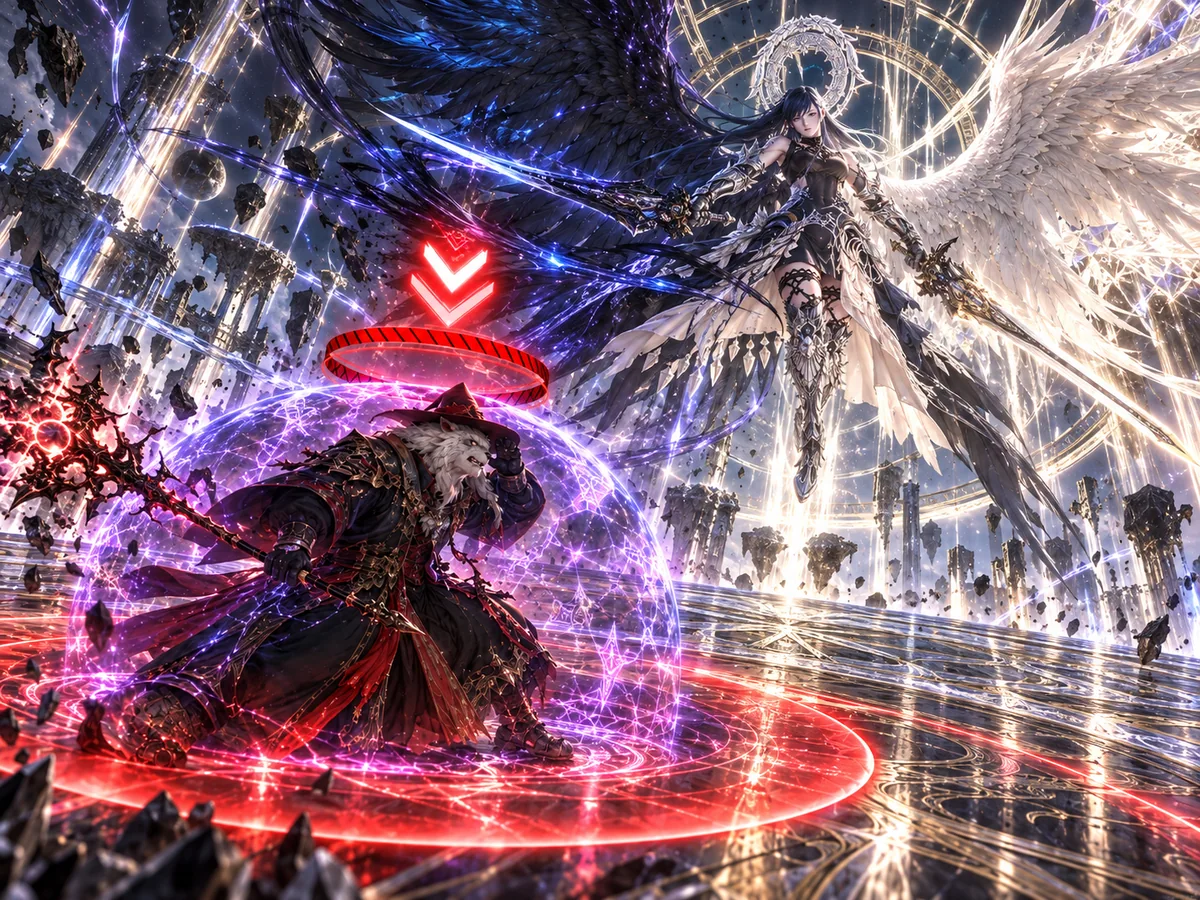
STUDY 03 / An idea becomes a scene
Manaward, before the impact
For the battle concept, I asked for the area-tankbuster marker to be adjusted and for the black mage’s Manaward to be visible. A small part of a busy composition became the focus of the next revision.
The image interprets Futures Rewritten (Ultimate) through fan art. Inspect how the shield, incoming marker and character pose suggest a moment before impact, then follow the creative notebook for the reference and revision context.
Can the intended instant be read through the effects?
THREE WAYS TO LOOK CLOSER / OPEN EACH NOTE
Find the intended instant+
Begin with the black mage’s pose, then inspect Manaward and the area-attack marker. How do they suggest the tension before impact?
Return to the revision request+
I asked for the area-tankbuster marker to be adjusted and the shield to be clearer. Read those details within the whole composition to see how a specific requirement affects the scene.
Continue with the reference context+
The complete creative notebook records the references and revision direction. Follow it for further encounter context; this reading focuses on how the fan-art scene communicates.
FROM THE ORIGINAL / TRY A NEXT STEPReturn from the scene to party agreements.+
Open the raid desk’s Chinese-server resources and turn a mechanic question into a preparation check.
- Choose a floor and consult the CN resources.
- Confirm the party’s variant and your responsibility.
- Keep one point to clarify or practise next.
Which agreement most needs checking before the pull?
Open the CN raid preparation deskPersonal creative direction / AI-assisted FFXIV-inspired fan art
Read the original context and case ↗Choose the left image from the piece rail and the right image here. Each original can be enlarged separately.
SCREEN 01 / An interface for a decision
Begin with the Monday decision.
The Monday screen is the entrance to our Kopi & Co group prototype. It organises the demonstration around the operating decisions a fictional COO needs to prepare, rather than asking the reader to begin with the full dataset.
Which question gets attention first?
THREE WAYS TO LOOK CLOSER / OPEN EACH NOTE
Follow the reading order+
Begin with the outlets needing attention this week, then inspect the proposed actions. The two sections let a reader ask separately where to look and what to prepare next.
Put the amount beside the question+
Waste, labour and service are different measures. Establish what each number represents, then return to the outlet and rule to understand why it appears.
Carry one decision forward+
Choose a recommendation and name the information you would need before acting. For a product or roster decision, use the full case to check the data’s granularity and available detail.
FROM THE ORIGINAL / TRY A NEXT STEPMake a Monday call yourself.+
After inspecting the entrance screen, follow the evidence into a choice in the decision theatre.
- Choose the issue you want to prioritise.
- Inspect the samples and make your next call.
- Open the review and revisit your reasoning.
Which piece of evidence changed your choice?
Enter the Kopi Decision TheatreKopi & Co / Final group prototype / September 2026 / Synthetic academic data
Read the original context and case ↗FIG. 2.5 / A model, opened up
Ask whose needs became goals.
Residents, visitors, transport agencies and local organisations expect different things from a greenway. The original diagram separates those needs so that later measures can be traced back to the people they are meant to serve.
Whose experience could disappear from the ranking?
THREE WAYS TO LOOK CLOSER / OPEN EACH NOTE
Recognise the people in the diagram+
Choose residents, visitors, transport agencies or local organisations and follow their relationships. The same greenway can serve different purposes for different people.
Connect a need to a goal+
Follow a need into a design goal, then ask whether the later measure responds to it. A clear goal gives the comparison something to return to.
Try an additional perspective+
Imagine a user group whose needs received less attention. Which goal might change? This is a present-day reading exercise to carry into the full project.
FROM THE ORIGINAL / TRY A NEXT STEPFollow a need into another project.+
Move from the greenway diagram to the school project and inspect how a user need reaches design and coordination.
- Read the project context and contribution.
- Open a theme in the interactive system map.
- Inspect the design, maintenance and team checks around it.
If a need changes, who needs to follow it through?
Open the sustainable-education casePedestrian Greenway Optimization System / Team report / 17 May 2023 / Report pp. 11
Read the original context and case ↗EXHIBITION NOTES / 24 OCTOBER 2026
Keep the work and its context together.
Kopi & Co · Interface originals
The three screens come from the published final group prototype, using synthetic academic data. The full case distinguishes my individual branch, the group artifact and later website exercises.
Greenway · Original team figures
The three figures come from the 17 May 2023 SYSEN 5400 Pedestrian Greenway Optimization System team report. Original English labels and page references are retained; the model used generated architectures and simulated survey inputs.
FFXIV · Character and scene studies
I shaped the character briefs, scene requirements and revision directions for these three AI-assisted fan-art studies. The creative notebook keeps the full images beside notes on roles, effects and references.
AFTER READING / THE CONVERSATION
What would you add?
Add an experience, ask a question or point out a correction. Both language editions share this article’s discussion.
Public comments are not open yet. Keep a draft on this device, or send your thoughts through the contact page.
Write a local draft
Only “Save on this device” stores the draft. Clear it on shared devices; it is not published automatically.
0 / 1600